
Young worker safety training matters to employers because a new hire cannot contribute safely until they understand the hazards, limits and supervision built into the job. As Team Canada Strong brings attention to growing the skilled trades workforce, employers can turn youth recruitment into a safer, more reliable hiring process by treating safety readiness as part of the pipeline, not a one-time orientation.
Make safety readiness part of the hiring plan
The federal backgrounder describes Team Canada Strong as an $8 billion investment intended to recruit, train and hire 80,000 to 100,000 new Red Seal skilled trades workers by 2030–2031. It also describes a $2 billion federal investment to support provincial and territorial workforce development efforts. For employers, the practical question is how to bring new entrants into real work without assuming that interest, a course credential or a first shift means a person is ready for every task.
That distinction matters when recruiting students and young workers. Some candidates may have classroom learning, a placement or prior experience with tools, while others may be encountering a worksite for the first time. Build a process that identifies what the person can do now, what needs instruction, and which tasks require close supervision or should wait.
The backgrounder is useful context, not a substitute for checking current programme details or workplace requirements. Employers can review the Team Canada Strong backgrounder, then translate workforce ambitions into their own job duties, training capacity and safety controls.
Young worker safety training starts with the work, not the age label
“Young worker” is not a complete risk assessment. A role’s hazards depend on the work, equipment, location, pace, and the worker’s experience and demonstrated competence. Employers should describe the actual tasks before recruiting, including which duties involve tools, vehicles, lifting, heights, chemicals, moving equipment or other hazards relevant to the operation.
Then separate duties into practical categories: tasks a new hire may perform after orientation, tasks they may perform only after demonstrated instruction, and tasks they must not perform until a supervisor confirms readiness. This is a management framework, not a replacement for applicable legal requirements or professional safety advice. It gives hiring managers a clear way to avoid vague promises that a new worker will “learn as they go.”
Check the rules that apply to the employer and worksite before finalizing duties, especially where a worker is under 18. Minimum ages, permitted hours and other requirements vary by province and territory; federally regulated workplaces also have specific restrictions for workers under 18. Confirm the applicable jurisdiction, sector and current requirements rather than relying on a general youth-hiring checklist.
Turn job requirements into a pre-start safety screen
A job posting should state the essential duties and the training the employer will provide, without suggesting that a young applicant must already have experience they are not expected to possess. At the same time, be clear about any genuine prerequisites, physical or site conditions, required availability, and the need to follow instructions and stop work when something is unclear.
Use hiring conversations to assess safety judgement, not just confidence. Ask candidates how they would respond if they were unsure how to use equipment, noticed a hazard, or were asked to do a task they had not been shown. There is no need to treat a polished answer as proof of competence; listen for willingness to ask, pause and follow the employer’s process.
Before the first shift, identify who will deliver orientation, who will supervise the worker, and who can answer questions when the primary supervisor is unavailable. Make sure schedules and work assignments leave enough time for instruction. If the team cannot provide that level of attention, revise the role or delay assigning higher-risk duties rather than treating training as something to fit in around production.
Build a repeatable first-shift and task-training sequence
Separate general workplace orientation from instruction for each task. Orientation can introduce site access, emergency procedures, reporting channels and basic workplace expectations. Task-level instruction should address the specific work, equipment, hazards, controls and conditions under which the worker must stop and seek help.
Use a consistent sequence for each assigned task: explain the hazard and safe method, demonstrate the work, have the worker describe the key steps, observe supervised practice, and confirm whether they can perform it as assigned. If they cannot yet do so reliably, identify the gap and arrange more instruction or a different task. A signature can document attendance, but it does not by itself show that a worker understands or can apply the instruction.
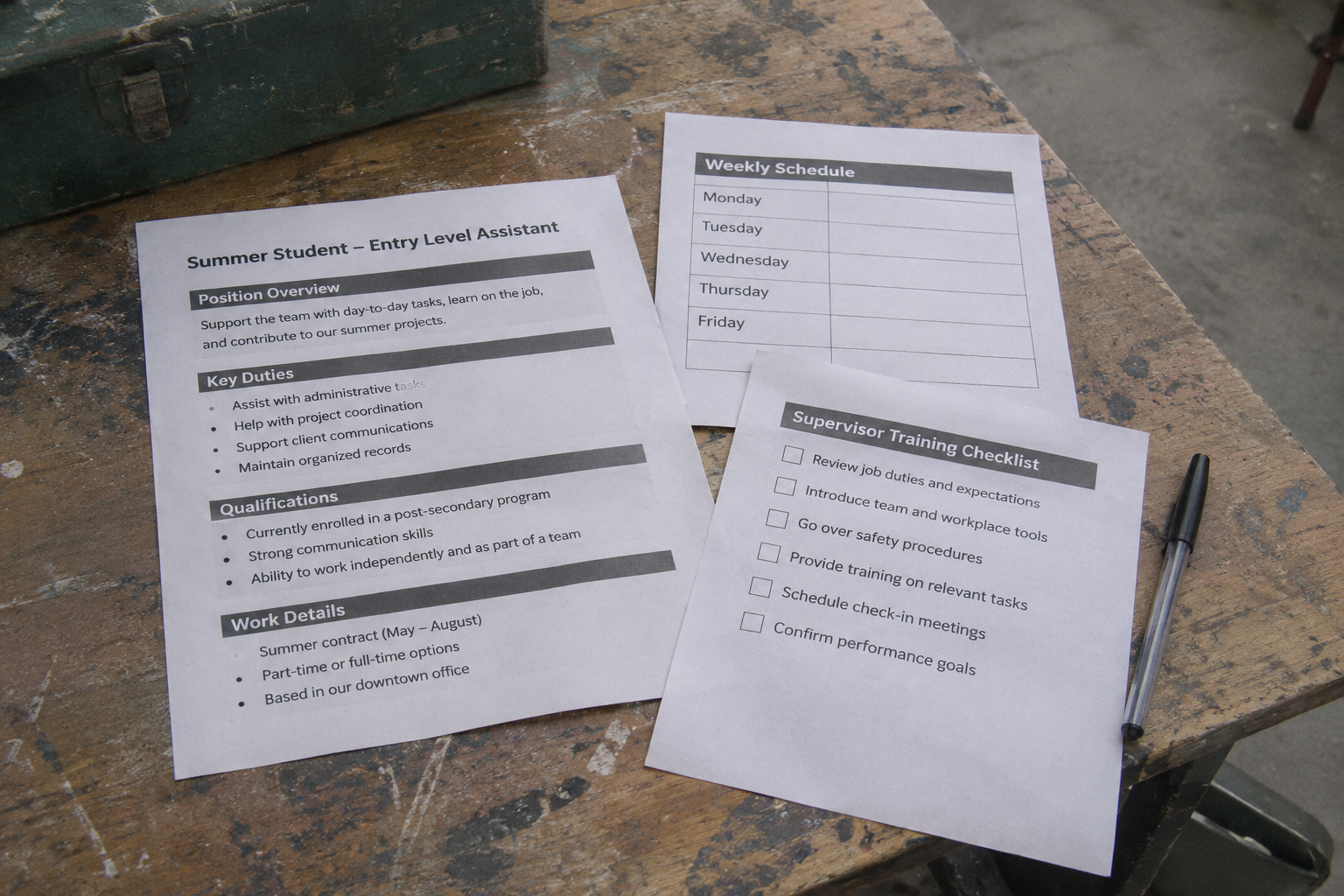
For a more complete first-week process, employers can use this guide to first-job onboarding for summer hires alongside a role-specific safety plan. Keep the safety record tied to the work: note what instruction was provided, who supervised practice, what the worker is cleared to do, and when a task or worksite change calls for another review.
Use supervision as a control, not a title
Assigning a “mentor” or “lead” does not establish that effective supervision is happening. Decide what the supervisor must observe, how often they will check in, how the worker can reach them, and who takes over when they are away. The level of oversight should reflect the task and the worker’s demonstrated readiness, and it should increase when conditions change.
Supervisors also need a clear way to respond to questions and mistakes. Make it normal for a new hire to pause a task, report a near miss or ask for a demonstration without being treated as a problem. When a worker reports uncertainty, reassess the instruction and assignment; do not assume that repeating the same direction or pointing to a written procedure has resolved the issue.
Review progress at planned intervals and after meaningful changes, such as new equipment, a different work area, a new task or a change in the worker’s level of responsibility. Keep feedback specific: what the worker did correctly, what needs practice, and what they are authorized to do next. A record of these decisions helps managers apply expectations consistently across shifts and teams.
Connect placements to a real employer pathway
Team Canada Strong Youth Placements is an Employment and Social Development Canada programme that funds eligible organisations to deliver paid, entry-level construction and trades work placements for youth aged 15 to 30, leading towards apprenticeships. It is not an employer wage subsidy, and an ordinary employer does not apply to it. Employers considering a placement should confirm the current programme details and determine whether an eligible delivery organisation is involved.
For an employer, the useful planning task is to define what a placement can safely include and what happens after it ends. Identify tasks suitable for supervised exposure, the learning objectives, the person responsible for oversight, and the evidence you would need before offering more responsibility. A placement should not be treated as a promise of a job or as proof that someone has completed the employer’s own training requirements.
Employers can also review their broader approach to training investments that address youth skills gaps. Keep the focus on the specific capabilities the role requires and the instruction the employer can deliver. Check the current status of any public funding before building a hiring plan around it; programmes can change, and funding eligibility is not the same as a legal or operational safety plan.
Put the process into practice
A small set of repeatable steps makes safety expectations clearer for recruiters, supervisors and new hires. Assign an owner for the process and review it when duties or work conditions change. Use the following checklist to connect recruitment with safe work assignment:
- List the actual duties and hazards for each entry-level trades role.
- Confirm applicable age, hours, training and workplace requirements for the employer’s jurisdiction and sector.
- State genuine prerequisites and the training the employer will provide in the job posting.
- Name the supervisor and backup contact before the worker’s first shift.
- Separate orientation from task-specific instruction and supervised practice.
- Record the tasks the worker is ready to perform, the limits that remain, and any follow-up instruction.
- Review readiness after changes in equipment, location, task or supervision.
Use the checklist as an operating tool, not a box-ticking exercise. If a new hire cannot explain the main hazards or demonstrate a task under the required supervision, the next step is more support or a different assignment—not an assumption that time on the job will automatically close the gap.
Make a safer pipeline visible to candidates
Employers competing for early-career talent can make their approach more credible by explaining how new hires learn, who supports them and how responsibility increases. That information helps candidates understand what the job involves and helps managers screen for a fit between the work and the employer’s training capacity. It also signals that safety expectations apply before a worker is sent onto a task, not only after an incident.
Build the process into recruitment materials, supervisor preparation and assignment records so it survives busy periods and staff changes. Then review whether new hires are receiving the instruction and oversight the role requires, and whether managers are making consistent decisions about readiness. Employers ready to recruit students, graduates and young workers can post a job on Canadian Youth Hire.