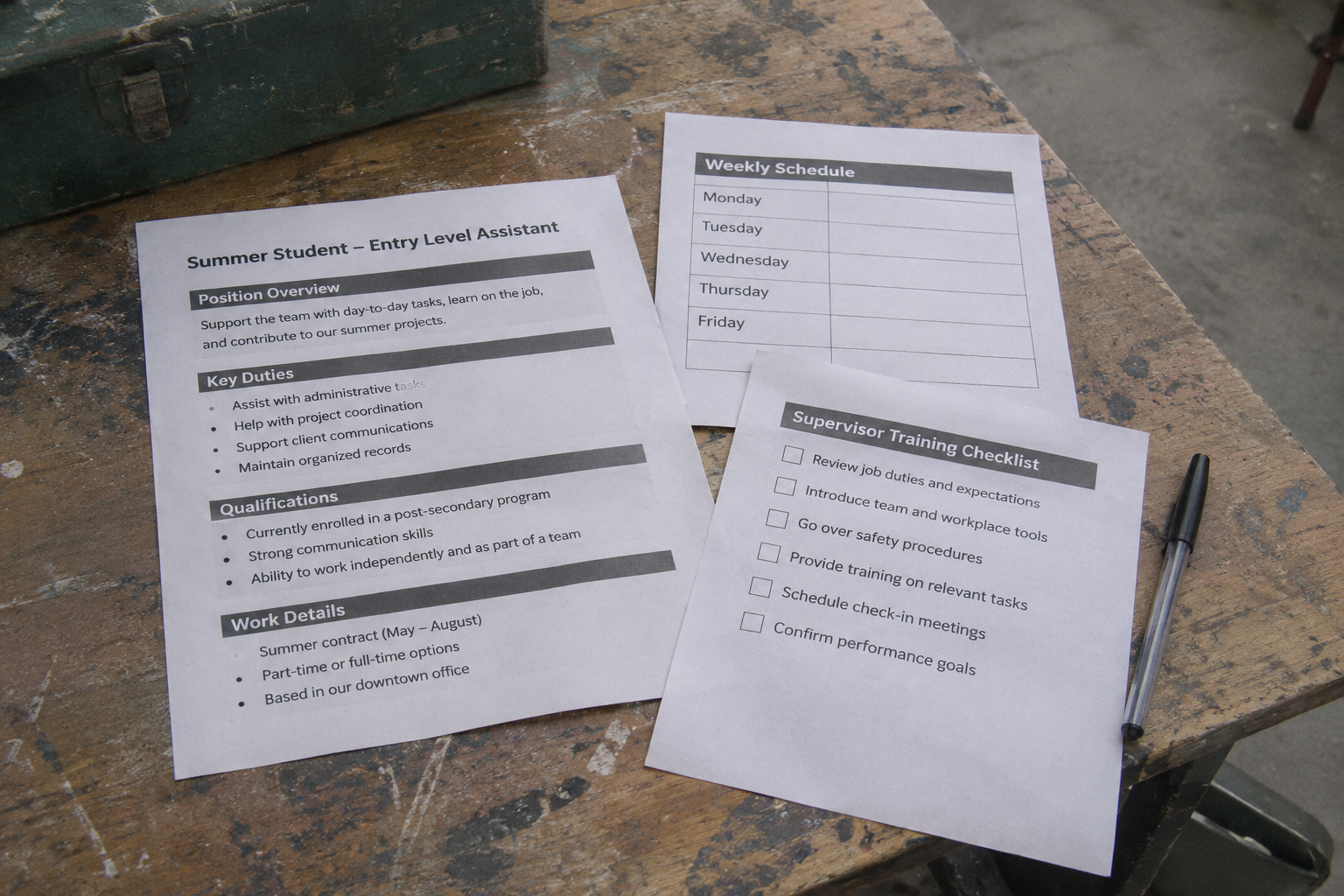

For employers planning to hire through Canada Summer Jobs 2027, first job onboarding can determine whether a young employee understands the work, knows where to get help and can contribute safely. A repeatable start also gives your team a practical way to assess skills and identify future hiring potential without treating a temporary role as a promise of permanent work.
Build first job onboarding before a candidate accepts
The Government of Canada’s backgrounder on Canada Summer Jobs 2027 is a timely prompt to plan how a summer hire will enter the workplace, not only how the position will be filled. Canada Summer Jobs is a wage subsidy programme under the Youth Employment and Skills Strategy, run by Employment and Social Development Canada, that supports paid summer work for youth aged 15 to 30. Employers should review the current Canada Summer Jobs programme information for programme details and requirements.
Funding and recruitment planning are only part of the work. Before recruiting, decide what a new employee needs to know on day one, what they should be able to do by the end of the first week, and who will provide instruction and answer questions. Put those decisions in writing so the hiring manager, supervisor and any colleagues involved in training are working from the same plan.
Start with the realities of the role: its recurring tasks, tools, work setting, schedule and points of contact with customers or colleagues. A position description should not promise broad training or responsibility that the team cannot deliver. For help defining duties at an appropriate level, consult the site’s guidance on writing entry-level job descriptions for Canada Summer Jobs positions.
Turn the role into a manageable learning plan
A first job may involve tasks a young employee has not done before, even when those tasks appear straightforward to an experienced worker. Break the role into a sequence: what the employee must observe, what they can practise with supervision, and what they may complete independently after demonstrating the required steps. Identify any tasks that must remain under direct supervision or require specific training.
Make learning outcomes observable. Instead of a general goal such as “learn the operation,” specify what the employee should be able to explain or complete, and who will confirm that they can do it. Keep the plan realistic for the length of the position. A short summer appointment may allow time to learn a defined set of duties, but not to master every function of a department.
Use a simple onboarding record with the task or topic, the person responsible for instruction, the date covered and a space to note follow-up. This is not a substitute for required training or workplace documentation. It helps the supervisor see whether essential information has been covered and prevents each team member from assuming that someone else handled it.
Prepare the workplace before the first shift
Complete practical preparations before the employee arrives. Confirm the reporting location, start time, schedule, supervisor’s contact details, access requirements, work clothing or equipment, and any documents the employee needs to bring. Tell the employee how to raise a question if instructions are unclear or plans change. Clear details reduce avoidable uncertainty during the first hours of a new job.
Check that the work area and tools are ready for the tasks the employee will perform. Arrange access to relevant procedures and make sure the person providing instruction has time to do so, rather than trying to fit onboarding around an unplanned workload. If the role involves several locations, shifts or supervisors, explain who is responsible at each point and how the employee can reach them.
Give the employee an agenda for the first shift, even if it is brief. Include introductions to key colleagues, an explanation of the role’s priorities, time to review procedures, a guided walk-through of the work area and a scheduled check-in. A predictable outline helps the employee understand that asking questions and learning the process are part of the work, not interruptions.
Make safety instruction specific to the actual work
Safety orientation should be based on the tasks, equipment and setting the employee will actually encounter. Explain the hazards relevant to those duties, the controls the workplace uses, the steps to follow if something goes wrong, and the person to notify. Do not rely on a general welcome presentation to cover details that matter at a particular workstation or worksite.
Show the task before expecting the new employee to perform it. Demonstrate the correct sequence, explain what to watch for, then observe the employee practising and correct misunderstandings promptly. Ask them to describe the key steps back in their own words. This check helps the supervisor establish whether instructions were understood rather than assuming that attendance at an orientation means the employee is ready to work independently.
Set boundaries for changing conditions. Tell the employee when to stop and ask for help, what to do if equipment or instructions do not match what they were taught, and how to report a concern. Assigning a named supervisor for each shift is especially useful when the usual manager is away. Employers should also check the rules that apply in their own jurisdiction and workplace; requirements can differ across Canada.
Use a steady check-in rhythm
Do not wait until the end of the summer to find out whether the employee is confused about priorities or struggling with a task. Schedule brief check-ins during the first days and continue them at a cadence that fits the work. Ask what is clear, what needs another demonstration, whether the employee knows whom to approach, and whether they have the tools and access needed to do the job.
Make feedback specific and tied to an observed task. Explain what was done well, what needs to change and what the next attempt should look like. Invite the employee to ask questions and raise a concern without having to frame it as a formal complaint. If an issue arises, agree on the next action and check back rather than leaving the employee with vague advice.
Record important instructions, progress and follow-up in a consistent way. Keep notes factual and relevant to work, and follow the employer’s normal practices for handling employee information. A useful record can help the supervisor distinguish a training gap from a task that needs clearer instructions, more practice or a different level of oversight.
Assess contribution without overpromising a next job
Use the final portion of the placement to review the employee’s work against the expectations set at the start. Consider reliability, demonstrated task skills, communication, safe work habits and how the employee responds to feedback. Assess the evidence available from the role rather than comparing a new worker with someone who has years of experience.
Give the employee a chance to reflect on what they learned and what work they would like to pursue next. Share clear feedback about strengths and areas to develop, and explain any realistic options your organization can offer, such as applying for a future vacancy if one is posted. Do not imply that a summer position will convert to continuing employment unless that decision has actually been made.
Close out access, equipment and outstanding work using a checklist. Ask the departing employee to document routine processes or hand over work that another team member will continue, while protecting confidential information. A planned close helps the team retain useful process knowledge and gives the employee a more professional end to the placement.
Review the process before the next recruitment cycle
After the placement, ask the supervisor what took more time than expected, which instructions had to be repeated and where the employee needed clearer authority or support. Review the onboarding record and identify gaps, such as a missing procedure or an unclear point of contact. Update materials while the experience is fresh, rather than waiting until the next summer hire is already on shift.
Look at the whole sequence from recruitment through the final handoff. If candidates arrived with an inaccurate picture of the duties, revise the posting and interview questions. If training depended on one person’s memory, create a checklist or demonstration guide. If a task was not appropriate for the employee’s experience or available supervision, change the assignment or arrange suitable instruction before offering it again.
Employers can also decide whether the role is a one-time seasonal need or a useful entry point to future vacancies. That assessment should reflect real staffing plans and the organization’s ability to supervise, not an assumption that every summer employee will return. Publish a clear opportunity when you are ready to recruit and invite qualified students and young workers to apply.
Canadian Youth Hire connects employers with students, graduates and young job seekers in Canada. Register as an employer and post a job to reach young candidates.