
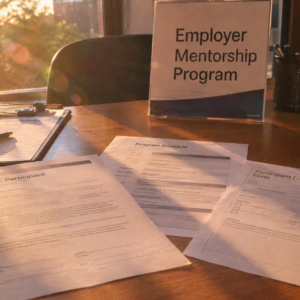
A mentorship program workplace can help employers meet emerging talent before a vacancy arises, while making expectations and conduct clear from the start. News about student bullying of professors is a prompt to plan for respectful, accountable relationships—not a reason to stereotype young people or treat ordinary disagreement as harassment.
What the reported research means for employers
HR Reporter’s coverage of research into student bullying of professors raises a useful workplace question: how does an organization respond when harmful conduct comes from someone with less formal authority? Employers should not assume that findings from an academic setting describe the prevalence or causes of behaviour in their own workplace.
The practical lesson is narrower. Mentorship, job shadowing and early-career outreach create relationships across differences in age, experience and authority. A sound program makes respectful conduct a shared expectation, gives participants safe ways to raise concerns and ensures that reports are assessed fairly rather than dismissed because of who made them.
That approach also protects the hiring pipeline. Students and graduates can learn what work involves and how the organization operates; employers can assess skills and interests over time. Neither side should have to accept intimidation, retaliation or unwanted conduct as the price of access to advice or future opportunities.
Design a mentorship program workplace participants can trust
Start by deciding what the program is for. It might introduce students to a field, help participants understand workplace expectations or give them structured exposure to a type of work. Define the intended outcomes before recruiting mentors so the program does not become an informal promise of a job or a substitute for a properly staffed position.
Set a written scope for the relationship. State its duration, expected contact, approved communication channels, confidentiality limits, meeting arrangements and how either person can pause or end the match. Explain that a mentor can offer guidance but cannot guarantee an interview, reference, placement or employment.
Be clear about the difference between guidance and supervision. If a participant is doing productive work, receiving direction and contributing to operations, do not use the word mentorship to avoid assessing the arrangement under applicable employment rules. Requirements can depend on the work and jurisdiction; check the rules that apply before a placement begins.
Make entry and exit straightforward
Give participants and mentors a named contact who is separate from the match. Tell them how to ask for a rematch, raise a concern or leave the program without having to negotiate directly with the other person. If the program is connected to a school or community partner, agree in advance how concerns will be routed and who will communicate with the participant.
For an employment transition, explain the separate steps. A mentorship match is not a hiring decision: any later recruitment should use stated criteria, a consistent assessment process and the same access to information for candidates. Employers developing their broader approach can also review guidance on planning early-career hiring.
Build a pipeline through useful, structured contact
A pipeline is a series of meaningful points of contact, not a promise that every participant will be hired. Employers can begin with an introduction to the work, offer a defined mentoring period, invite participants to learn about relevant openings and then use a transparent application process when roles are available. Keep the steps optional and explain what participation does—and does not—mean for future selection.
Offer more than one way to take part. A participant may benefit from a short conversation, a group information session or a work-focused activity, while another may need a different format to participate effectively. Ask about access needs and practical barriers without requiring someone to disclose personal information that is not needed to deliver the program.
Coordinate with education or community partners where appropriate, but agree on roles before launch. Decide who identifies participants, prepares mentors, handles accommodation requests, keeps records and responds to concerns. Do not ask a partner to screen out people based on a reported conflict or complaint without a fair, relevant process.
To turn the relationship into a credible hiring route, tell participants where vacancies will be posted and how to apply. Use the same job-related criteria for participants and other candidates, and do not imply that a mentor’s personal approval is a hiring qualification. If a participant is hired, make the change in role explicit and provide the normal employment terms and onboarding information.
Set conduct rules for both sides
Mentors should receive practical guidance before they are matched. Cover respectful communication, professional boundaries, privacy, conflicts of interest, feedback and the process for escalating a concern. Explain that a mentor should not retaliate against a participant who challenges advice, declines an activity or makes a report.
Participants also need clear expectations. Describe acceptable ways to disagree, communicate, use organizational systems and respond to feedback. Apply expectations consistently: a participant’s age or junior status should not make a legitimate concern less credible, and a mentor’s seniority should not exempt them from conduct standards.
Use a short written agreement and revisit it during the program. It should identify prohibited conduct in plain language and explain that repeated unwanted contact, threats, discriminatory behaviour or attempts to interfere with someone’s work may require a response under organizational policy. Have the appropriate person assess concerns rather than asking the mentor to resolve a complaint about their own behaviour.
Train mentors to give feedback without using power as pressure
Good feedback is specific, connected to an agreed goal and delivered in a way that lets the participant ask questions. Mentors should distinguish an error in a task from a judgement about someone’s character, and should avoid making access to advice or opportunities conditional on personal loyalty or silence.
For a broader foundation on preparing young hires for work hazards and reporting, see the guidance on young worker safety training. A mentoring program is not a replacement for required safety instruction, workplace procedures or supervision when someone is doing work.
Make reporting safe, prompt and fair
Give everyone more than one route to raise a concern, including a contact outside the mentor-participant relationship. Explain who receives a report, what information may be shared and what the next steps could be. Do not promise absolute confidentiality if the organization may need to investigate or take action.
When a concern comes in, focus first on immediate safety and whether contact or the match should pause while the issue is assessed. Record the account in a factual way, preserve relevant communications where appropriate and avoid asking the person reporting to confront the other party. Keep the response proportionate and impartial; a report is a reason to assess, not proof of misconduct.
Protect against retaliation and explain how participants can report it. Retaliation may be less visible than the original conduct, so check whether access to meetings, advice or opportunities changes after someone speaks up. Follow the organization’s policies and applicable requirements, and seek qualified advice when the issue raises legal or safety questions.
Close the loop with each person to the extent privacy permits. Tell them whether the concern has been received, who is handling it and how they can raise further issues. If a match ends, arrange a neutral handoff or rematch where appropriate, without treating the act of reporting as a reason to exclude a participant from future hiring.
Choose measures that improve the program
Track whether the program is working for both participants and the organization. Useful measures can include whether matches start and finish as planned, whether participants understand the conduct and reporting process, whether they can access the agreed activities, and whether they apply for relevant openings. Interpret participation and hiring outcomes carefully; a small or self-selected group does not establish that the program caused an outcome.
Ask for feedback in a way that does not require participants to criticize a mentor face to face. Use a contact outside the match, offer a private channel and explain who will see responses. Review themes, not gossip, and restrict access to personal information to people who need it to administer the program or address a concern.
Use what you learn to adjust the design. If participants are unsure how to report a problem, make the routes easier to find. If mentors are unclear about their role, revise the agreement and preparation. If hiring managers treat program participation as a shortcut around normal assessment, restate the selection rules and audit how candidates are evaluated.
Make the next step a transparent hiring process
A well-designed mentorship program builds familiarity and gives participants a realistic view of the work. It does not replace job descriptions, fair screening, appropriate supervision or a clear employment offer. Keep recruitment decisions with trained decision-makers and document how candidates meet the requirements of a role.
Review the program before each new cycle with the people who run it and those who take part. Confirm that the scope, conduct expectations, reporting contacts and partner responsibilities remain accurate. A trusted route into work depends on both opportunity and the ability to raise concerns without losing access to that opportunity.
Ready to reach students and graduates with a clear, well-supported opportunity? Post a job on Canadian Youth Hire.