
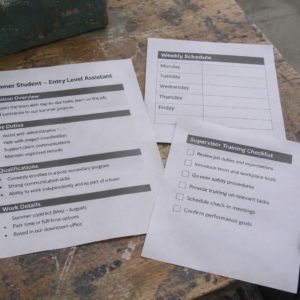
Clear entry level job descriptions help employers decide what work a young hire will actually do, who will support them and what skills the role requires. With the Canada Summer Jobs 2027 application period open until December 3, 2026, it is a useful moment to turn a staffing need into a well-defined role.
Use the application window to define the work
The application period is a deadline, but role design should not be reduced to filling in a form quickly. The federal announcement says employers can apply until December 3, 2026; see the Canada Summer Jobs 2027 application announcement for the news item. Give yourself time to decide what work needs doing and whether a young employee can take it on with appropriate direction.
Canada Summer Jobs is a wage-subsidy programme under the Youth Employment and Skills Strategy, run by Employment and Social Development Canada. The programme is for paid summer work for youth aged 15 to 30. Before putting time into an application, check the current Canada Summer Jobs programme information for eligibility, requirements and application guidance. A well-written description supports your planning; it does not guarantee funding.
Confirm your organisation’s eligibility and budget assumptions before finalising the role. Not-for-profit employers can receive funding for up to 100% of the provincial or territorial minimum wage, while public and private sector employers can receive up to 50%. Private sector organisations must have 50 or fewer full-time employees to be eligible. Treat these as maximum funding levels, not a promise that a specific position’s costs will be covered in full.
Start with the work, not a generic junior title
Begin with the work your team needs completed during the summer. List the tasks, recurring responsibilities and any defined deliverables, then ask which of them can reasonably be assigned to an employee who is new to the workplace. A role title such as “summer assistant” does not tell an applicant what the work involves or help a supervisor plan the employee’s day.
Separate essential duties from occasional or optional tasks. Note which tasks require judgement, access to sensitive information, physical effort, specialised knowledge or coordination with other staff. If a task cannot be completed safely or independently until the employee has received instruction, say so in your planning and build that instruction into the role rather than treating it as an unstated prerequisite.
Next, check that the amount of work fits the position’s planned hours and duration. A list of broad responsibilities can conceal an unrealistic workload; a shorter set of clearly scoped duties is easier to explain, supervise and review. If the team’s need changes during the summer, identify who will decide whether the employee’s priorities should change.
Make entry level job descriptions specific and honest
A useful description explains the role’s purpose, main duties, reporting relationship, expected schedule and work location or arrangement. Use plain language and active verbs to show what the employee will do. Where the work is seasonal or tied to a particular project, state that clearly so applicants can assess whether the role fits their availability and interests.
Describe the work as it is, not as an idealised version intended to attract more applicants. Be candid about routine tasks, customer contact, outdoor work, busy periods or other meaningful conditions. Do not label a position as a training opportunity if most of its duties do not include instruction, practice or feedback. Accuracy helps both sides form realistic expectations before the first day.
Keep the description aligned with the information your organisation provides elsewhere during recruitment and selection. If the advertised duties, interview questions and actual work differ, a new employee may arrive with the wrong expectations and the supervisor may have difficulty assessing performance fairly. For broader planning considerations, the earlier guide to preparing to hire summer students for Canada Summer Jobs can complement this role-by-role drafting work.
Set qualifications that match the real task
For each proposed qualification, ask whether it is needed on the first day or can be taught after hiring. Distinguish required credentials or demonstrated capabilities from preferences that would simply make onboarding easier. If the role provides training, avoid screening out applicants for not already having a skill the position is meant to develop.
State what a requirement means in practical terms. Instead of relying on broad labels such as “excellent communication,” identify the relevant activity: for example, explaining information clearly, recording details accurately or asking for help when instructions are unclear. These are task descriptions, not assumptions about an applicant’s personality or background.
Review language that could narrow the applicant pool without a clear connection to the work. Consider whether every listed qualification is necessary, whether you can assess it consistently and whether the wording makes the role accessible to people with different levels of experience. Keep any legitimate requirements, but explain them plainly and avoid adding inflated experience expectations to a genuinely entry-level position.
Build supervision and learning into the role
A young employee should know who assigns work, who answers questions and who gives feedback. Name the role responsible for supervision in your internal plan, even if the public description uses a job title rather than an individual’s name. Decide who will provide coverage when that supervisor is away, and how the employee can raise a concern or request clarification.
Break complex or unfamiliar duties into teachable steps. Identify what the employee should observe, practise with support and then complete with less direct guidance. This makes training easier to organise and gives the supervisor a basis for checking progress. It also helps prevent the common planning mistake of treating a new hire as immediately independent simply because the job description lists the work.
Choose a few observable measures of satisfactory work before recruitment begins. Depending on the role, these might relate to accuracy, completion of assigned tasks, following established procedures or timely communication with a supervisor. Avoid promising a particular learning outcome unless you can provide the instruction and opportunities needed to support it.
Include schedule, workplace conditions and safety planning
Set out the expected days, hours, duration and any schedule flexibility you can genuinely offer. If the schedule depends on operational needs, explain what is known and how changes will be communicated. Avoid advertising a pattern that the team cannot maintain, and make sure the planned hours match the work you have assigned.
Assess the working conditions behind each duty, not only the wording in the advertisement. Consider the worksite, equipment, public or customer interaction, travel between locations, physical demands and any hazards associated with the tasks. Decide what instruction, equipment, supervision and procedures are needed before the employee begins that work. A job description is not a substitute for workplace safety planning.
Age-related employment rules and limits on student hours differ by province and territory. Check the requirements that apply where the work will take place rather than assuming a single rule applies across Canada. If the role is in a federally regulated workplace, check the relevant federal requirements as well; do not assume that rules for one type of workplace apply to every employer.
Check the description against your application plan
Use the role description to test whether your proposed work, supervision and budget fit together. Check the current Canada Summer Jobs application instructions for what information the application asks you to provide; do not assume that a general job description covers every required field. Keep a record of decisions and confirm that the duties described to applicants are consistent with the role you plan to propose.
Review the staffing plan with the person who will supervise the employee and the person responsible for the budget. Ask whether the workload is feasible, whether required training can be delivered and whether the supervisor has time to provide it. For additional context on aligning a funding request with workforce needs, see the guide to planning around the Canada Summer Jobs grant, while checking current programme guidance for this application round.
Make the description a working document rather than a one-time advertisement. If the application or operational plan changes, review the duties and schedule before recruitment. If the actual work changes after hiring, explain the change to the employee and check that the revised tasks remain appropriate, supported and within the organisation’s plan.
Use the description through recruitment and onboarding
Once the role is defined, use the same core duties to prepare screening questions and interview prompts. Ask candidates about relevant experience or how they would approach a task, rather than testing qualifications the position does not require. Use a consistent set of role-related criteria when comparing applicants, and keep room for transferable skills that can be developed with instruction.
Before the employee starts, turn the description into a first-week checklist for the supervisor. Identify the people, systems, equipment and procedures the employee needs to learn, and make sure someone is assigned to introduce each essential part of the work. A short, specific plan is more useful than expecting a new hire to infer priorities from a broad list of duties.
During the summer, compare assigned work with the description and discuss progress regularly. This lets the supervisor identify unclear instructions or training gaps early. At the end of the role, note which duties were appropriate for an entry-level employee and which need a different scope or level of support in a future hiring cycle.
Prepare a practical final review
Before submitting an application or publishing an advertisement, use this short review:
- Write the role’s purpose in one clear sentence and list its main duties.
- Separate first-day requirements from skills the employer will teach.
- Confirm the reporting relationship, planned schedule and work conditions.
- Identify the supervisor, training time and process for questions or feedback.
- Check that the workload is realistic for the role’s hours and duration.
- Review provincial or territorial requirements that apply to the workplace and employee.
- Compare the description with the current programme guidance and the information in your application.
This review helps employers avoid treating a job title or funding opportunity as a complete hiring plan. The strongest description is one your hiring team, supervisor and new employee can all use to understand the work and what support is available.
When your role is ready, publish it where students and young workers can find it. Register as an employer on Canadian Youth Hire and post your opportunity.