
For employers hiring students, graduates and young workers, AI adoption can affect what a role asks people to do from their first shift. The reported gap between AI use and worker support makes gen z workplace expectations a practical hiring-plan issue: candidates need a clear account of the work, the tools and the human help available.
Turn the AI news into a hiring question
HR Reporter’s coverage of the report says half of workers hurt by AI cite stress, while training and role-level guidance lag. For employers, the useful signal is not a reason to assume every young worker feels the same way. It is a prompt to check whether the roles you plan to fill explain how AI affects the actual work.
Before opening a requisition, ask whether the role will use AI tools, whether those tools change tasks or expectations, and who will answer questions when the output is unclear. If you cannot explain those points to a candidate, the role may not yet be ready to recruit for. Clarifying the work can help prevent a mismatch between the job you advertise and the job a new hire encounters.
Use gen z workplace expectations to define the role
Do not treat a generation as a single set of preferences. Instead, use gen z workplace expectations as a reason to make your offer concrete: describe duties, supervision, learning opportunities and the tools people will use. Clear information gives candidates a basis to decide whether the role suits them, regardless of age.
Separate essential duties from tasks that may be supported or changed by AI. State which work still requires the employee’s judgment, what quality standards apply, and how a person should handle an uncertain result. Avoid implying that access to a tool automatically means an employee has the expertise or authority to rely on its output.
Review the role description for language that hides important details. Phrases such as “AI-enabled” or “digital-first” are not a substitute for explaining what the employee will do. For practical guidance on setting out duties and requirements, see this resource on writing entry-level job descriptions.
Map the work before you post
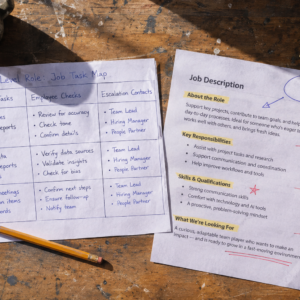
Build a simple task map for each opening that may involve AI. It does not need to be a technical assessment; it needs to show what the employee is accountable for and where a person checks the work. This is especially useful when a role combines routine tasks with customer, operational or administrative responsibilities.
- List the core tasks and identify which ones may involve an AI tool.
- For each use, name the intended purpose and the limits employees should observe.
- Identify who reviews outputs before they affect a customer, colleague or business decision.
- Specify what employees should do when information is incomplete, inconsistent or outside the task’s scope.
- Decide where employees can raise concerns or ask for help, including when their direct supervisor is unavailable.
This map can reveal that a role needs more oversight or a narrower scope before hiring begins. It may also show that the tool is not central to the position and should not dominate the job advertisement. Make the hiring plan reflect the work as it will actually be assigned, not an aspiration to automate more later.
Make support part of the staffing plan
Training is not only a course or a link to instructions. New hires need to know when they are expected to use a tool, how to check its output, and what to do if it does not fit the task. Assign a named role or position responsible for questions, and make time for that support in the team’s workload.
For each planned hire, decide what must be learned before independent work begins and what can be learned while working under review. Set the level of supervision according to the task and its consequences, rather than assuming that a young worker will either need constant direction or already know how to use every tool.
Be explicit about the boundaries of the role. If employees must not enter certain information into a tool, rely on its output for a particular decision, or use it without approval, tell them before they begin that work. These are operational instructions, not fine print to leave for an employee to discover after a mistake.
Screen for judgment, not tool familiarity alone
Hiring criteria should match the responsibilities you have defined. If the role requires checking information, protecting confidential material or escalating uncertain results, assess those abilities directly. Do not make a candidate’s familiarity with a particular AI product a stand-in for judgment, communication or the ability to follow procedures.
Use consistent questions tied to the work. Ask candidates how they would verify information before using it, when they would seek review, or how they would handle instructions that conflict. Make clear whether a question is about a tool the employee will actually use or a general work skill, and assess answers against the same criteria.
Review the selection process as well as the job duties. Decide whether any AI tool is involved in screening or evaluating applicants, who checks its results, and how a candidate can ask about the process. If your team cannot explain what a tool contributes to a hiring decision, pause and establish that explanation before relying on it.
Set expectations before the first shift
Recruitment should not promise support that the team has not arranged. Before making an offer, confirm who will provide task guidance, where instructions are documented, and how a new hire can raise a concern without guessing which person to approach. If a position changes after the advertisement goes live, update candidates before they make a decision based on outdated information.
At the start of employment, walk through the actual tasks and clarify what good work looks like. Check that the employee understands when to use AI, when human review is required, and how to report an output that seems wrong. A structured first-job start can help you organize those conversations; this guide covers first job onboarding for summer hires.
Set a follow-up point to compare the advertised role with the work being assigned. Ask whether the tool is being used as planned, whether instructions are usable and whether the employee has access to the promised reviewer. Use what you learn to adjust the role description and support plan for the next hire.
Make this quarter’s plan concrete
As you review upcoming vacancies, distinguish between roles that are ready to post and roles that need more definition. A practical sequence can keep hiring moving without asking new employees to resolve unclear decisions on their own:
- List the positions you expect to recruit for this quarter and flag any with AI-related tasks.
- Complete a task map and write down the limits, review points and escalation route for each flagged role.
- Confirm who will train and support the new hire, and make sure that responsibility fits the team’s capacity.
- Revise the advertisement and selection criteria so they reflect real duties, not assumptions about age or technical confidence.
- Brief interviewers and supervisors on the same role expectations before candidates are assessed.
- Schedule a check after the employee starts to see whether the described work and actual support match.
If any step has no clear owner, treat that as a planning gap rather than a candidate shortcoming. You may need to narrow the role, delay a tool-related task or assign additional review before the hire can work independently. The decision should follow the risks and responsibilities of the work, not a blanket assumption that AI is either harmless or unsuitable.
Recruit with a credible account of the work
Young candidates are not a uniform audience, and a hiring plan should not rely on broad claims about what a generation wants. Employers can make a stronger case by being specific: describe the tasks, the tools, the limits on their use and the human support available. That clarity also helps managers align interviews, onboarding and day-to-day supervision.
When your role is defined and ready, post it on Canadian Youth Hire, a Canadian job board connecting employers with students, graduates and young job seekers in Canada. Register as an employer to prepare your posting.