
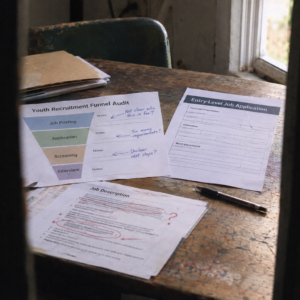
Youth employment barriers can begin before a young person ever reaches an interview, leaving employers with a smaller pool of potential candidates. The federal statement marking National Child Day 2026 is a timely prompt to examine whether your recruitment process makes a first opportunity understandable and reachable.
Use National Child Day as a prompt to review access
The publication of the statement marking National Child Day 2026 gives employers a reason to look beyond the number of vacancies they post. A youth hiring pipeline also depends on whether young people can find, understand and navigate the route into a role.
This is a practical employer question, not a request to make assumptions about what young people need. Review each stage against the actual requirements of the work: what candidates must know, what they must provide, where they must go and how quickly they must respond. If a step does not help assess a necessary job requirement, consider removing or changing it.
The aim is not to lower standards or promise a job to every applicant. It is to make relevant standards visible and avoid excluding capable candidates because of unclear instructions, unnecessary screening hurdles or inaccessible ways of applying.
Where youth employment barriers enter the hiring funnel
Map the process from the first time a candidate encounters the vacancy through the final hiring decision. Include the job posting, application form, initial screening, interview, any assessment and communication about the outcome. Ask someone who did not design the process to follow it using only the information a candidate receives.
At each stage, note the action required, the information candidates need and the time allowed. Look for steps that depend on prior workplace experience, specialised vocabulary, personal contacts or access to equipment that is not essential to the job. These may screen for familiarity with recruitment rather than ability to perform the work.
Also look for practical friction: a form that cannot be completed on a phone, an unclear way to ask a question, an interview location without directions, or a request for documents before candidates understand why they are needed. Treat these as review points, then confirm whether they reflect a genuine business or job requirement.
Make the vacancy answer the questions candidates need to decide
A useful posting helps a young applicant decide whether to apply. State the core tasks, the expected schedule or scheduling process, the location and the skills that matter at entry. Separate requirements that are essential on day one from capabilities that can be developed after hiring.
Use plain language and explain terms that may be familiar inside your organisation but unclear to a first-time applicant. Describe the steps in the selection process and any materials candidates should prepare. If the role has specific physical, technical or availability requirements, describe them accurately rather than relying on broad phrases that invite guesswork.
Review every qualification against the work itself. If a credential, previous job or particular software experience is not necessary, decide whether it should be optional or removed. Clear criteria can help candidates judge their fit and give hiring teams a more consistent basis for reviewing applications.
For more detail on making entry-level requirements explicit, use this guide to writing entry-level job descriptions. Apply its practical principles to the role you are hiring for, without copying language that does not fit your actual duties or conditions.
Assess potential against the work, not familiarity with hiring
When a position is designed for early-career applicants, a long list of previous job experience can conflict with the role’s entry-level purpose. Identify what a successful person must be able to do, what can be learned on the job and what evidence would reasonably show readiness. Then use those criteria consistently for all applicants.
Applications should request only information the hiring team needs at that stage. Consider whether every field is necessary before deciding who to interview, and whether a candidate can explain relevant experience gained through education, volunteering, community activities or other responsibilities. Do not treat a lack of formal employment history as automatic evidence of a lack of ability.
Structured questions can help interviewers focus on the requirements of the job. Prepare a common set of prompts, identify the qualities each prompt is intended to assess and use a shared evaluation guide. Leave room for candidates to ask questions and explain their answers; avoid turning an interview into a test of unwritten expectations.
If you use automated tools or other technology to support recruitment, examine how the system affects who advances and whether the criteria match the role. This guide to using AI in student hiring can help frame a review of how technology fits into selection decisions.
Offer an early look at the work without making a job promise
Some candidates may not know what a role involves or how a workplace operates. Employers can make the work more legible before asking someone to commit to an application by providing a clear role preview, answering questions about the process or explaining the kinds of tasks involved. Choose an approach that fits the role and does not imply that a preview guarantees employment.
Make the boundaries clear. Say whether the activity is an information session, an assessment or part of the selection process, and explain what candidates will be asked to do. If you invite candidates to demonstrate a skill, ensure the task is relevant to the job and communicate its duration and purpose in advance.
Do not use unpaid productive work as a substitute for a proper hiring process. If you are considering an internship or work experience arrangement, check the rules that apply to your workplace and location before setting it up. Requirements can differ between federally regulated workplaces and other employers, and provincial or territorial rules may also apply.
Access to an early introduction should not depend only on a candidate having a personal connection to your organisation. Share opportunities through channels that are relevant to the people you want to reach, and make the same basic information available to all interested candidates.
Check age, location and process requirements before recruiting
Young workers are not one uniform group. The rules that apply can depend on a candidate’s age, the work, the workplace and the province or territory. Minimum working age, student work hours during the school term and internship rules are not the same across Canada, so check the requirements for the location where the work will take place before publishing a posting or setting a schedule.
Build that check into role approval rather than leaving it until after you select a candidate. Confirm that the planned tasks, hours and work setting are suitable under the rules that apply. If the job could involve more than one location, account for the requirements in each relevant jurisdiction instead of assuming one set of rules covers all placements.
Keep the candidate-facing information accurate. Do not advertise hours or duties that you may later need to change because of an age-related restriction or other applicable requirement. When you are unsure, pause the recruitment decision and seek current guidance for the jurisdiction rather than relying on an informal assumption.
Give candidates a predictable and respectful process
Uncertainty can discourage applicants, especially when they are unfamiliar with hiring conventions. Tell candidates how to apply, how the selection process is expected to proceed and how they can contact the hiring team with a question. A clear process does not require a lengthy policy document; it requires consistent information at the points where a candidate needs it.
Set realistic response expectations and follow them. If a decision will take longer than anticipated, send an update where practical. When you close a competition, communicate that it has ended rather than leaving applicants to infer the outcome from silence. These actions support a more credible employer experience without promising a particular result.
Review the process for unnecessary costs or access demands. Ask whether candidates must travel before it is necessary, obtain equipment at their own expense or use a single communication method that may not work for everyone. Where a different format or way to participate is feasible, provide a clear route to request it and decide requests based on the actual needs of the selection process.
Consistency matters across the hiring team. Ensure interviewers know the approved criteria, who will respond to candidate questions and how evaluation notes should be recorded. A shared process reduces the chance that individual preferences will quietly replace the requirements stated in the posting.
Turn the audit into an employer action plan
A review is useful only if it leads to changes that someone owns. Start with the friction points most likely to prevent a suitable candidate from applying or completing a fair assessment. Record the issue, the reason for changing it, the person responsible and when the revised process will be used.
- Map the stages: List every candidate-facing step from discovery of the vacancy to the hiring decision.
- Test the instructions: Check whether a new applicant can understand the duties, requirements, schedule and next steps without internal knowledge.
- Challenge each screen: Keep only criteria and application questions that relate to the role or a necessary hiring decision.
- Check jurisdiction: Confirm the applicable age, hours and work-arrangement rules for the job’s location.
- Standardise assessment: Give interviewers shared questions, job-related criteria and a clear way to record decisions.
- Review after hiring: Ask where applicants paused or sought clarification, and update the process before the next recruitment cycle.
Track practical signals rather than relying on a single impression. Note where candidates abandon an application, which instructions generate repeated questions and whether hiring teams frequently waive stated requirements. These observations can reveal a process problem; they do not, on their own, explain why an individual candidate did not continue.
Apply the same review to recurring entry-level vacancies, not only to a special youth recruitment campaign. A well-designed process can make it easier for young candidates to participate while also giving hiring teams clearer evidence to assess. The result is a more deliberate route from interest to a hiring decision.
Build a pipeline by making the first step reachable
Employers do not need to create a complex new programme before improving access. A realistic first step is to revise one vacancy, remove a screening requirement that does not serve the job, or make the application instructions easier to follow. Keep the changes tied to the duties and the hiring process you can actually deliver.
Use feedback to decide what to adjust next. If candidates repeatedly ask about schedule, pay, location or required experience, make that information easier to find. If a step is difficult to complete, investigate whether the same decision can be made through a clearer or more proportionate method.
National Child Day is a useful moment to consider how early opportunities are presented, but the work continues in every recruitment cycle. Employers that make expectations clear and review avoidable obstacles can give more young people a fair chance to show whether they meet the role’s real requirements.
When your next student, graduate or young-worker vacancy is ready, post it on Canadian Youth Hire and make the opportunity clear to young talent across Canada.